
Brief
Assignment two provides a creative opportunity to put into practice what you have learnt so far, by exploring the physicality of the book in relation to its function and working through the design process in relation to a set brief.
Your brief
Design the book format and cover artwork for two different versions of Daniel Defoe’s classic 1719 novel Robinson Crusoe. The publishers, Viking Press, have decided to re-release this title as a new pocket edition for readers on the move that reflects the adventurous nature of the story within a contemporary setting. This paperback version should have a modern visual feel that can compete with new titles in the bookshop. They also want a deluxe edition for armchair readers and classic book collectors that references the historical nature of the story and its associations. Produce book design ideas and cover artwork to reflect the content of the story across both formats and contexts. Be creative and inventive with both the look and format of these books.
As a side project to accompany the re-release of R obinson Crusoe, Viking Press has also asked you to design a new book called Washed ashore: The ultimate guide to surviving on a desert island by Rik Bennett. This is a ‘how to’ guide that should reflect not only the practical advice it offers, but something of the adventure of being a castaway.
The scale, stock and binding of these publications are up to you. The pocket edition needs to celebrate the functionality of the book as a lightweight, transportable object, and to connect to the story’s travel or survival themes in a contemporary way. The deluxe edition can present the content in a larger, finer, more luxurious, considered or expanded way, that perhaps makes reference to the history of the book itself. Your designs need to be seen as part of a series across both versions, so think about how you adapt your designs to fit each format. The shipwreck guide needs to be seen as a separate genre, piggy-backing on the success of R obinson Crusoe. Develop visual ideas that can distinguish the survival guide from your R obinson Crusoe designs, while at the same time making some thematic connection between them.
Your design should include the front, back, spine and flaps of your covers – if you opt for a traditional book binding. You can also come up with alternative ways of binding, and therefore designing your books if you want to. Generate your own illustrations, photography or artwork for the covers, source copyright free images, or treat the covers purely typographically. This is an opportunity to be creative with both your design thinking and outcomes, so experiment, and test out a range of visual and physical options.
You may want to extend your project by also designing a number of sample pages from the inside of the book. When creating sample pages, try to make a link between the cover design and the design of the inside pages.
Present your ideas by mocking up each of the books and their covers, and by presenting the overall spec of your designs (what paper stock you are using, etc.).
Daniel Defoe, Robinson Crusoe, 1719. Title Page and Cover featuring engraving by John Clark and John Pine after design by unknown artist. Wikipedia.
“From this moment I began to conclude in my mind that it was possible for me to be more happy in this forsaken, solitary condition that it was possible I should ever have been in any other particular state in the world; and with this thought I was going to give thanks to God for bringing me to this place.”
Daniel Defoe, R obinson Crusoe, 1719
Work through the design process, documenting it in your learning log as you go. Use rough drawings, notes, diagrams, mock-ups of your books, photographs of what you’re working on, and by saving different stages of any digital work to show your process. Talk about your creative process through notes and reflections.
Research and ideas
Read the brief, identifying keywords, and do the same for Defoe’s text. You don’t have to read the whole book, but make yourself broadly familiar with the story and identify key themes, motifs and images. The full text of the novel is available here: h ttp://www.gutenberg.org/ebooks/521
Identify the research you need to undertake. This could include researching existing versions of this cover, others of the same genre, or seeking inspiration elsewhere. The same goes for your survival guide. This brief requires some lateral thinking, so develop ideas that are unexpected, as well as the obvious. Generate thumbnail sketches to document and explore your creative thinking process. Aim to come up with a range of different ideas from which you can select and test different outcomes.
Present visual outcomes
Develop your initial ideas through making, drawing, collage, photography or whatever other mediums you choose. Be playful and let new ideas emerge through your making process. See this as a project, rather than a linear journey, so you may want to return to earlier stages of the process to develop new lines of visual enquiry or to take creative risks and try new things out.
For the deluxe edition of the book, you may want to access the Bridgeman Library to source copyright free illustrations from previous editions of the book.
Think about how your choice of scale, paper selection, and binding can help support your ideas in visual and tactile ways. If you are unable to source particular materials, then find other ways of visualising or describing your choices.
Lay out the jacket using DTP software and incorporating text and image(s). Design a range of versions of the jacket to choose from. Print the jacket designs and make a mock-up of the jacket onto either an existing book, or find other ways of mocking up the scale of the books. Photograph both versions of the book jackets as your final outcome to the project brief.
Reflection
Reflect on your outcomes but more so on your creative process – what worked for you, and how might you adapt these approaches for future projects?
Just a reminder to think about how well you have done against the assessment criteria and make notes in your learning log.
Analysing the brief
- What have I been asked to design? 1) Robinson Crusoe – Pocket edition 2) Robinson Crusoe – Collector’s Edition 3) How to survival guide
- Who is the target audience? Adventure enthusiasts
- How will it be produced? Paperback and hardcover
Keywords
- 3 books
- Paperback
- Hardcover
- Classic
- Adventurous
- Part of the series
- Modern
- Contemporary
- Including: title, author’s name, publisher’s name and trademark, price, barcode, endpapers
Primary Research
- About Robinson Crusoe
- Previous book covers
Secondary Research
- Inspiration
- Material
- Dimensions
About Robinson Crusoe
The novel Robinson Crusoe tells the story of a young and impulsive Englishman that defies his parents’ wishes and takes to the seas seeking adventure. The young Robinson Crusoe is shipwrecked and castaway on a remote tropical island for 28 years. The story may be based on the true-life events of Alexander Selkirk, a Scottish castaway who survived four years on a Pacific island, or Henry Pitman, a political rebel surgeon castaway from a Caribbean penal colony. This classic tale of adventure features cannibals, captives, and mutineers. Some regard it as the very first modern novel written in the English language, launching the publishing industry.
Daniel Defoe published Robinson Crusoe on April 25, 1719. Its original title must not have fit on the cover: “The Life and Strange Surprizing Adventures of Robinson Crusoe, Of York, Mariner: Who lived Eight and Twenty Years, all alone in an un-inhabited Island on the Coast of America, near the Mouth of the Great River of Oroonoque; Having been cast on Shore by Shipwreck, wherein all the Men perished but himself. With An Account how he was at last as strangely deliver’d by Pyrates.”
Who is the real Robinson Crusoe?
With any truly great novel, the questions are usually the same. Where did the story come from? What inspired it? Were the characters or plot based on real-life elements? But these tried-and-true questions might mean a little more when asked about Daniel Defoe’s 1719 debut novel Robinson Crusoe, a book literary scholars the world over regard as one of the first realistic fiction novels and one that helped popularize the form we still crave today.
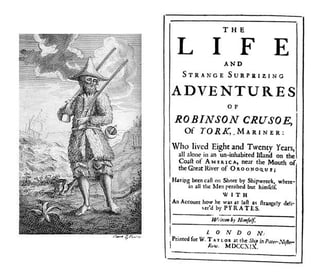
Presented as something of an autobiography of the book’s titular character, the novel details the 30 years Crusoe spent as a castaway on a remote tropical island near what is now Trinidad. Throughout the story, Crusoe encounters cannibals, other captives, and mutineers before finally being rescued right at the novel’s end.
It’s part faux-travelogue, part diary, and part adventure novel, and Defoe’s ability to create vivid, heart-pounding scenes of action, intrigue, and romance paved the way for centuries of aspiring-writers to tell their own stories of adventure and peril.
But where did Robinson Crusoe come from? How did Defoe—who held a number of interesting professions, including a trader, writer, and spy—harness the elements of the story and mold them into this classic English novel?
Theories abound on the origins of the novel and the source material Defoe had at his disposal. Even today, nearly 300 years after its initial publication, academics and scholars still quibble over the search for the real Robinson Crusoe and the story behind the story.
Previous book covers

Elements used in previous book covers:
- People
- Island
- Palm tree
- Sea
- Wreck ship
- Leaves
- Fire
- Stormy night
- foot step
- Gun
- Parrot
- Mostly coloured
- Different typeface
Secondary Research
Standard Book Sizes Info
Here is a list of standard book sizes that are manufactured in the UK. If you produce your book at a standard size then you are ensuring that it is printed in the most cost effective and efficient way.
However we do not insist that you stick to these sizes and can produce custom sizes.
Please note that if you are measuring a hardback book on your bookshelf then you need to measure the inner book block and not the outside of the case to find out the size that we would need to give you an estimate on.
Book (trim) size – Height x width
- A6: 148 x 105mm
- A Format: 178 x 111mm
- B Format (UK): 198 x 129mm
- B Format (US): 203 x 127mm
- A5: 210 x 148mm
- Demy: 216 x 138mm
- American Royal: 229 x 152mm
- Royal: 234 x 156mm
- Pinched Crown Quarto: up to 248 x 171mm
- Crown Quarto: 246 x 189
- A4: 297 x 210mm
For the pocket size book, I’m going to choose “B Format” and “A4” size for the hardback, collector’s edition. Size for the How-to-book would be “A6”, 105 x 148 mm.
Materials


Uncoated Types of Paper:
Wide range of use for almost all genres
80 gsm Opaque
This is our most common paper type. It is a plain white, smooth paper, similar to what you would print documents at home on. There is a slight show through but not noticeable unless you have heavy printing to one side.
Good for:
- Non-fiction and poetry books
- Keeping the price of your book low
- Keeping the weight of your book low
100 gsm Opaque
This is the same type of paper as our 80gsm opaque paper but at 100gsm. This will give your book a more premium feel and will have less show through than the 80gsm paper.
Good for:
- Non-fiction and poetry books
- Giving your book a premium feel
- Any books with illustrations, images or any colour artwork
80 gsm Bookwove White
Our bookwove papers are what you would find in most novels. They are not as smooth as the opaque paper types we have and help to ‘bulk’ your book up. The bookwove white paper is actually an off-white paper and will look cream when held next to a pure white opaque paper. Bookwove paper is also available in heavier weights but please contact us if you want to find out more.
Good for:
- All fiction books
- Black and white printing
- ‘Bulking’ up the thickness of your book
80 gsm Bookwove Cream
Our bookwove cream paper type is identical to our bookwove white paper apart from the colour. The bookwove cream paper is still suitable for all types of books but it is most commonly used for novels. Any colour printing on the cream paper will not reproduce very well.
Good for:
- All fiction books especially novels
- ‘Bulking’ up the thickness of your book
- Giving your book a traditional feel
100 gsm Recycled
This paper type is similar to our 100gsm opaque paper but it is not quite as smooth and being recycled paper it is not as white. The recycled paper type is great for making your book feel more premium like the opaque paper type but also with the added impact of being fully recycled.
Good for:
- All fiction and non-fiction
- Giving your book a premium feel
- Eco-conscious
Coated Types of Paper:
Mainly used for books with lots of illustrations or photographs
115gsm Coated – matt / gloss
This is our lightest gsm coated paper which is fantastic for books that have any type of illustrations or photographs. We use this paper type for our mono and colour inserts as plate sections within your book. Because this paper type is a low gsm, it works well if you want a coated paper and your book has a lot of pages, 100+.
Good for:
- All non-fiction genres
- Keeping the weight of the book low
- A premium book at a lower cost
130gsm Coated – matt / gloss
As the paper types get heavier the page count of the books is usually less to keep the weight of the book down. This particular gsm of paper is a good middle ground between a non-fiction book with a lot of pages and a regular photo book. If your book is over 100 pages and you want a coated paper, it may be best to opt for the 115 gsm as your finished book can start getting heavy.
Good for:
- Most non-fiction genres
- Any book with colour or mono illustrations or photographs
- Children’s books
150gsm Coated – matt / gloss
This gsm of paper is a great paper type for photo books or books with a high amount of colour and mono images with under 100 pages. This is a premium paper that will give your book a fantastic feel.
Good for:
- Non-fiction books with lots of illustrations or photographs
- Photobooks
- A Premium book
170gsm Coated – matt / gloss
This is our most premium paper type for the internals of your book. It is a fantastic paper reserved for those special photo books or any book that you want to last. As the paper is a high gsm it is a lot tougher than the previous paper types.
Good for:
- Photobooks
- Any premium book
- Children’s books that need a strong paper
Mind mapping

Thumbnails

Design process
Design 1: Paperback
For the pocket book, I’ve chosen, sun, palm tree and a silhouette of a man. The main colour, I chose first was orange then changed it to green from palm tree leaves. I wanted to have the same colour pallet throughout three designs.
I made the illustration in Procreate and moved it to Photoshop for making final book cover design.
The cover of the paperback novel would be 240gsm with a gloss lamination to give the book some protection. For the paper 80gsm Bond paper seems a good choice to keep the cost down.


Design 2: Hard cover
Again for the second design, I started with Procreate. Then moved it to Photoshop for the final design.
I chose Papyrus condensed for the title as it got a rustic feel. However I changed it Georgia Regular as it was looking more sophisticated to be used in the series.
The original typeface was Savoye LEG for the author’s name and changed to Futura for the consistency throughout the designs.
The typeface that used for the blurb is Roboto Regular.
400gsm board for main book covers, with 120-150gsm uncoated pages. Spine sealed with a material such as a textured paper to create the green spine.


Design 3: How-To-Guide
300gsm cover, uncoated for more durability in ‘survival mode’. 120gsm inner pages, uncoated — paper made from a blend of grass or other plant materials to give the more natural feel. The island icon to be beveled to give a raised touch. Perfect bound due to size and scale.


Mockups


Self – reflection
It was a very challenging assignment as the material needed to be considered as well as designing. It was quite hard to come up with some new ideas as this book is very historical with lots of different book covers over the years.
I probably needed more sketches before choosing my final designs. However, I am happy with the final designs. I think I managed to portray my ideas in the best way that I could.
Overall, I enjoyed working on this assignment. As it helped me to understand about other elements, like materials apart from designing. Looking forward to working on next assignment.
Resources
- American Literature. Robinson Crusoe. At: https://americanliterature.com/author/daniel-defoe/book/robinson-crusoe/summary. (Accessed: 26/04/2022)
- Books Tell You Why. A blog about book. At: https://blog.bookstellyouwhy.com/who-is-the-real-robinson-crusoe. (Accessed: 26/04/2022)
- Biddles. Book printing. At: https://www.biddles.co.uk/book-printing/book-sizes-info/. (Accessed: 27/04/2022)
- Google images. Robinson Crusoe book covers. At: https://images.google.com/?gws_rd=ssl. (Accessed: 26/04/2022)


 Maryam: OCA Graphic Design